


Louisiana’s Black Leaders Deliver Emotional Plea as Congress Map Fight Reopens Deep Wounds of History
Current and former members of Congress, state lawmakers, and civil rights advocates filled a Senate committee room as lawmakers debated whether Louisiana should maintain two congressional districts that allow Black voters the opportunity to elect their preferred candidates.

BATON ROUGE, La. — Louisiana’s Capitol became the stage for an extraordinary and emotional gathering Friday as generations of Black political leadership came together to defend minority representation during a congressional redistricting fight many described as a defining moment for democracy in the state.
Current and former members of Congress, state senators, representatives, and civil rights advocates packed a Senate committee room as lawmakers debated whether Louisiana should preserve two congressional districts in which Black voters can elect candidates of their choice.
What unfolded was part legislative hearing, part history lesson, and part warning.
Seated before lawmakers together were Congressman Cleo Fields, Congressman Troy A. Carter, former Congressman Cedric Richmond, and former Congressman William Jefferson, the only four African Americans elected to Congress from Louisiana since Reconstruction.
“And you’re looking at all of them,” Fields told the committee in one of the hearing’s most powerful moments.
The hearing followed a U.S. Supreme Court action allowing lower court rulings against Louisiana’s current congressional map to stand, forcing lawmakers back into special session to redraw district boundaries ahead of upcoming elections.
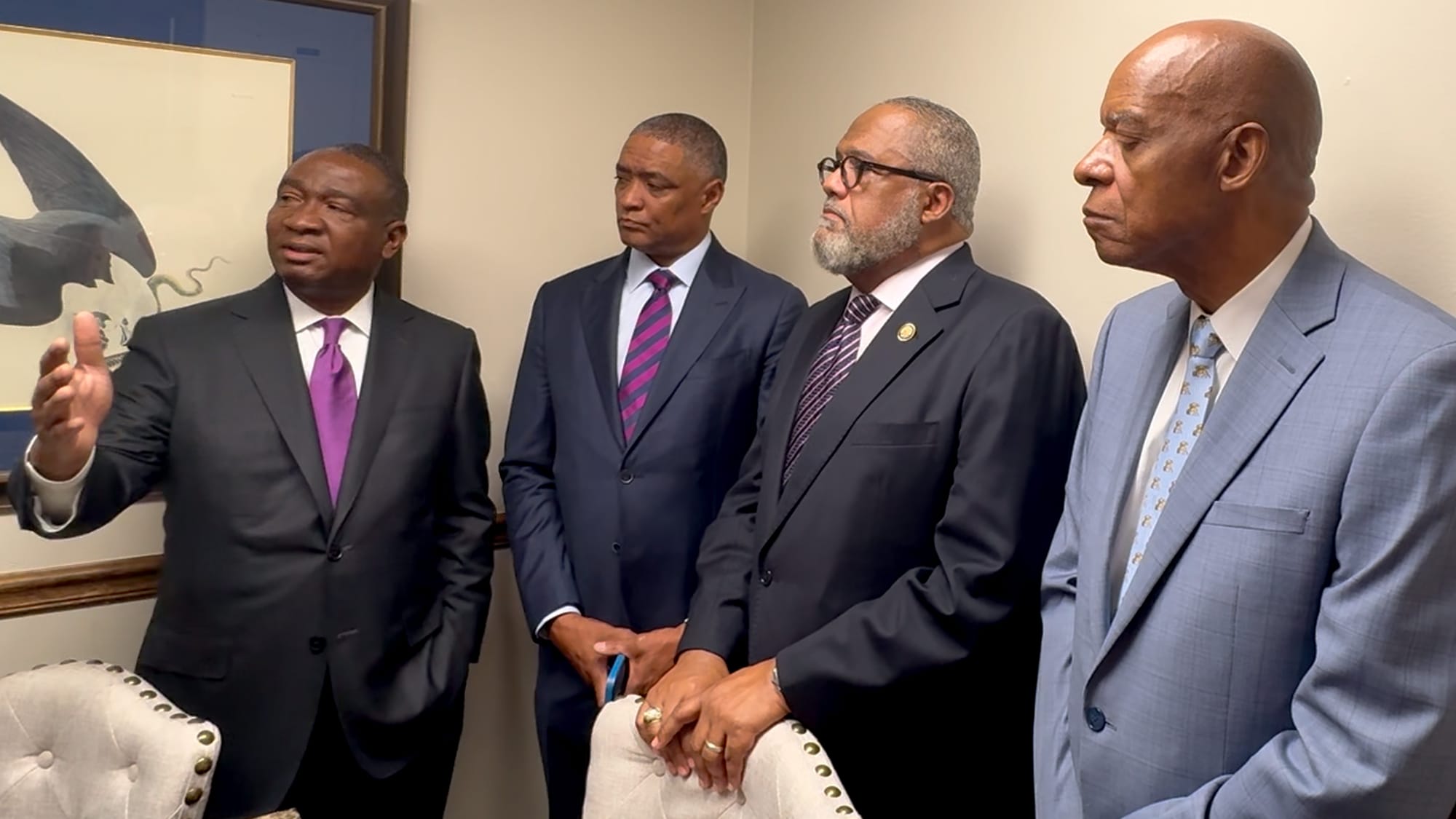
The central question looming over the Capitol was whether Louisiana, a state where African Americans make up roughly one-third of the population, would continue maintaining two opportunity districts or move toward a congressional map dominated almost entirely by Republicans.
Former Congressman Cedric Richmond delivered a blistering critique of Congress, accusing federal leaders of harming poor and working-class communities while weakening educational and healthcare opportunities.
“You can’t cut education and continue to tell people that education is the best way out of poverty,” Richmond said. “We wouldn’t be cutting healthcare. We wouldn’t be cutting SNAP.”
Richmond called the moment “a clarion call for unity” and urged voters not to disengage politically despite growing frustration and distrust.
“Keep advocating, keep fighting, keep marching,” Richmond said. “But whenever you do it, do it with a voter registration card in your hand.”
Fields spoke with the weight of history behind him, recounting how John Willis Menard, the first Black man elected to Congress from Louisiana after the Civil War, was denied his seat despite winning his election.
“He won by 64% of the vote,” Fields said. “And they sent him home.”
Fields reminded lawmakers that despite Louisiana’s large Black population, African Americans have remained dramatically underrepresented in Congress for more than a century.
“Since Reconstruction, Louisiana has elected four African Americans to Congress,” Fields said. “Four.”
Congressman Troy Carter responded emotionally to that reality, questioning how lawmakers could justify reducing Black representation even further.
“Since the 1870s all the way through present, just you four gentlemen — that’s it,” Carter said. “And now this body wants to reduce that? How do we not be outraged?”
“This is embarrassing,” he added.
Former Congressman William Jefferson focused much of his testimony on preserving “communities of interest” and ensuring lawmakers used the flexibility still allowed under recent court rulings to protect fair representation instead of dismantling it.
Jefferson argued lawmakers should focus on what courts said they still could do rather than only what they could not do under the latest legal decisions.
Several lawmakers struggled to contain emotion throughout the hearing.
Louisiana Senate President Pro Tempore Regina Barrow fought back tears as she reflected on seeing every Black congressman elected from Louisiana in her lifetime sitting together before the committee.
“In my lifetime, less than 60 years old, all four are sitting before me,” Barrow said. “That is a sad indication.”
Barrow described growing up watching previous generations fight for voting rights and representation so future Black leaders could have opportunities they were once denied.
“There were people who opened the door so that we could serve and sit here,” she said. “I don’t take that for granted.”
Representative Edmond Jordan, chairman of the Louisiana Legislative Black Caucus, delivered one of the hearing’s sharpest historical warnings, connecting the current fight to Louisiana’s long history of racial exclusion.
“In 1867 and 1868, we had 42 African Americans in this legislature,” Jordan said. “By 1900, we were down to zero.”
Jordan argued that African Americans in Louisiana have repeatedly seen political gains rolled back through courts, laws, and redistricting battles.
“We have always had to fight for our freedom,” Jordan said. “We have never had the luxury of taking freedom for granted.”
Jordan also accused some lawmakers of surrendering independent leadership for partisan loyalty.
“I’ve never seen a place that’s supposed to be so full of leaders, so full of followers,” he said.
State Sen. Regina Barrow, State Sen. Cleo Fields, and State Sen. Troy A. Carter were repeatedly praised throughout testimony for what lawmakers described as bipartisan leadership and advocacy for all Louisianians.
State Sen. Patricia Haynes Smith Jenkins thanked the congressional delegation for putting “a face” on why fair maps matter and warned against partisan extremes.
“We need fair maps in this state,” Jenkins said. “We need the opportunity to elect candidates of our choice.”
Lawmakers repeatedly referenced the proposed “Price map,” supported by many Black lawmakers and Democrats, which supporters argued would preserve two Democratic-leaning districts while maintaining four Republican-leaning districts.
Fields called the proposal balanced and legally sound.
“This is a perfect plan,” Fields said. “It creates two Democratic districts and four Republican districts.”
Republican Sen. Valarie Hodges Morris presented several competing congressional maps and defended the Legislature’s need to act after courts ruled Louisiana’s current maps unconstitutional.
“We are here because the current configuration of our congressional maps has been declared unconstitutional by the United States Supreme Court,” Morris said.
Outside the hearing room, demonstrators, clergy members, students, and voting-rights advocates filled Capitol hallways as tensions over race, political power, and representation intensified.
Jordan warned lawmakers that many residents now feel anger, confusion, and desperation as the future of Black representation hangs in the balance.
“They are not motivated by joy to be here,” Jordan said. “They are here because they understand what’s at stake.”
As the hearing closed, the image of Louisiana’s four Black congressmen seated together remained one of the most striking moments of the special session — a reminder of how rare Black congressional representation has been in Louisiana history, and how fiercely many leaders are now fighting to protect it.


