


Whoever Wins Louisiana’s 6th Must Remember Who They Work For
The race to replace Cleo Fields is bigger than party labels. It is about whether the next representative will answer to Louisiana voters or Washington politics.

BATON ROUGE, La. — The race to replace U.S. Rep. Cleo Fields is shaping up to be one of the most consequential congressional contests in Louisiana, not simply because a seat is open, but because the district itself has been fundamentally transformed.
Fields, a Democrat, announced July 21 that he would not seek reelection after Louisiana's congressional map was redrawn. Instead, he is seeking to return to the Louisiana Senate. The redistricting followed an April U.S. Supreme Court decision that struck down the previous congressional map.
That leaves voters with a fundamental question:
Whoever wins the new 6th Congressional District — who will they work for?
The answer should be neither the president nor a political party.
They work for the people of Louisiana.
This is no longer Cleo Fields' district
The distinction is important.
Fields won the former 6th District in 2024 after Louisiana was ordered to create a second majority-Black congressional district. That map gave Black voters in central and northern Louisiana a stronger opportunity to elect a candidate of their choice.
The Supreme Court later rejected that map, and the Legislature approved a new congressional configuration that eliminated the second majority-Black district.
The result is a substantially different 6th District — one that is considerably more favorable to Republicans.
Fields recognized the political reality and chose not to spend another campaign trying to defend a district that no longer resembles the one that elected him.
But his departure should not mean that the people who live in the newly drawn district become an afterthought.
They are still entitled to representation.
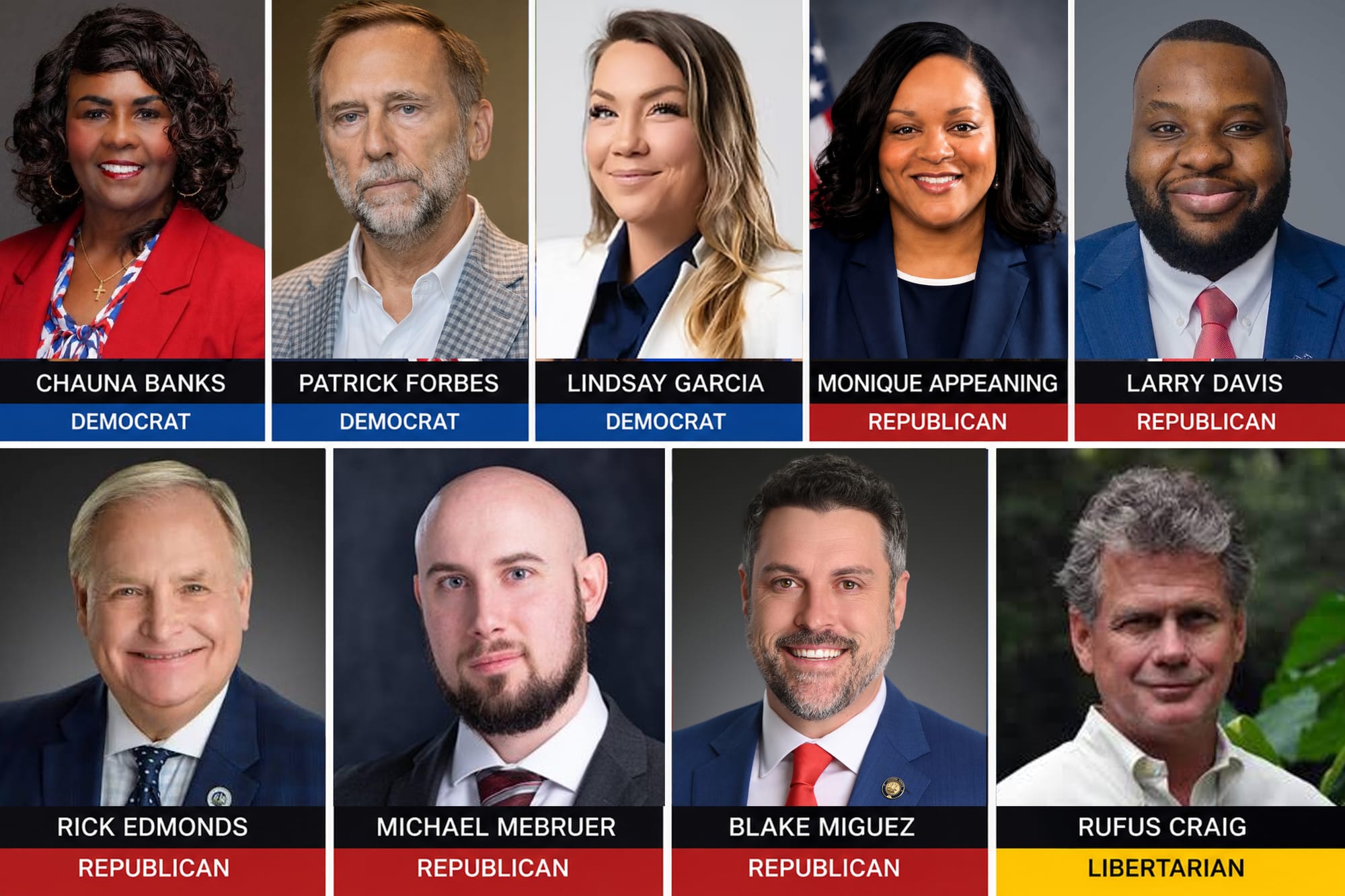
Meet the people seeking the seat
The field is larger than some early reports suggested.
Candidates currently listed for the 6th District include Democrats Chauna Banks, Patrick Forbes and Lindsay Garcia, Republicans Monique Appeaning, Larry Davis, Rick Edmonds, Michael Mebruer and Blake Miguez, and Libertarian Rufus Craig.
One previously announced Republican, Christian Johnson, is no longer on the ballot.
That makes this an important race to watch — and an important race for voters to study.
The winner will inherit a district that has been politically redesigned, but that does not relieve the winner of the responsibility to represent every constituent.
A Republican victory does not mean a blank check
The new district gives Republicans a significant structural advantage.
But winning a congressional seat does not give any elected official permission to ignore voters who did not support them.
That principle should be made clear before Election Day.
If a Republican wins the 6th District, Black voters, Democrats, independents and other voters who may have supported another candidate should not be told to sit down and accept whatever Washington decides.
They should ask questions.
They should demand meetings.
They should attend town halls.
They should call the congressional office.
And they should keep a record of the representative's votes.
Because the congressional office does not belong to the Republican Party.
It does not belong to the Democratic Party.
And it certainly does not belong to the White House.
It belongs to the people.
The president is not the boss
This point deserves special emphasis in the current political environment.
A president — regardless of who occupies the Oval Office — has enormous influence over members of his or her political party.
Presidents endorse candidates. They campaign for candidates. They pressure members of Congress. They negotiate with congressional leadership.
But congressional representatives take an oath to support and defend the Constitution of the United States.
Their constitutional responsibility is to legislate, conduct oversight and represent their constituents.
That means a member of Congress should be able to disagree with a president — even a president from the same political party — when the interests of Louisiana require it.
That is not betrayal.
That is representative government.
Louisiana should expect more than a party-line vote
The next representative should be judged by a simple standard:
What are you doing for the people who sent you to Washington?
For residents of the 6th District, that means asking candidates where they stand on the issues that directly affect Louisiana families.
What will they do about Medicaid?
What is their position on Medicare and Social Security?
What will they do to strengthen public education?
How will they support historically Black colleges and universities?
What will they do about federal infrastructure dollars?
How will they address flooding and disaster recovery?
What is their plan for economic development?
What will they do for small businesses?
How will they protect voting rights?
And perhaps most importantly for a district that includes communities with dramatically different economic circumstances:
How will they make sure federal resources reach the people who need them most?
Those questions should be asked of every candidate — Republican, Democrat or Libertarian.
Black voters have not lost their voice
The elimination of the second majority-Black congressional district is a serious political development.
But it should not be interpreted as the elimination of Black political power.
Black voters remain a significant constituency throughout Louisiana.
And voters do not surrender their influence simply because district boundaries change.
Political power also comes through organization, turnout, advocacy, coalition-building and holding elected officials accountable after Election Day.
That may be the most important lesson from the Fields era.
Fields' political career demonstrates that district lines can change. Political fortunes can change. Parties can change. But voters remain.
The question is whether voters will remain engaged.
Don't just ask candidates who they support. Ask who they will represent.
The 6th District race deserves more than campaign slogans and endorsements.
Candidates should be required to explain how they intend to represent communities that may not share their political ideology.
That is particularly important if the district ultimately elects a Republican.
A Republican representative should be expected to represent Democrats.
A Democrat should be expected to represent Republicans.
An independent or Libertarian should be expected to represent everybody.
That is how democracy is supposed to work.
The representative does not get to choose which constituents count.
The Baton Rouge Weekly Press challenge
As this campaign develops, voters should resist the temptation to make the election simply about Donald Trump, Cleo Fields or the Republican-versus-Democrat divide.
Those are parts of the political landscape.
They are not the whole job.
The real question is whether the next representative will have the courage to tell Washington, "I was elected to represent Louisiana."
If the president supports a policy that benefits Louisiana, support it.
If the president supports something that hurts Louisiana, say so.
If congressional leadership proposes legislation that helps Louisiana families, vote for it.
If it harms them, vote against it.
That is representation.
The people of Louisiana's newly drawn 6th District deserve nothing less.
Cleo Fields may be leaving Congress, but the responsibility of holding his successor accountable will belong to the voters.
And if a Republican wins the seat, there should be no misunderstanding from Day One:
You may carry the Republican label. You may have the president's endorsement. You may have Washington's support.
But the people of Louisiana are your employers.
Don't ever forget who you work for.


