

Sleeping in Darkness: Could a Simple Nighttime Habit Help Protect Your Heart?
Research suggests that sleeping with lights on may increase the risk of cardiovascular disease. While blackout curtains and sleep masks are not proven to prevent heart attacks, scientists say a darker bedroom could be an important part of protecting long-term heart health.


The Weekly Press | Health & Wellness Editorial
For generations, people have been told that a good night's sleep is essential to maintaining good health. But emerging research suggests that how dark your bedroom is while you sleep may be nearly as important as how many hours you spend resting.
Scientists studying the relationship between nighttime light exposure and cardiovascular health have found concerning associations between sleeping in illuminated environments and an increased risk of heart disease.
The findings raise an intriguing possibility: Something as simple as closing the curtains, turning off the television or wearing a comfortable sleep mask could contribute to better heart health.
But before anyone rushes out to purchase blackout curtains, there is an important distinction to understand. Research supports reducing nighttime light exposure, but it has not established that blackout curtains or eye masks themselves prevent heart disease.
That distinction matters, particularly at a time when heart disease remains the leading cause of death in the United States.
What the latest research reveals
A study published Sept. 9, 2026, in the European Heart Journal provides additional evidence supporting the connection between nighttime light exposure and cardiovascular health.
Researchers examined more than 11,000 participants whose exposure to light was measured using wrist-worn sensors. Approximately three years later, cardiovascular MRI scans were used to evaluate the structure and function of their hearts.
Participants with greater nighttime light exposure were more likely to exhibit changes associated with cardiovascular problems, including thickening of the heart's main pumping chamber and reduced efficiency in how the heart contracts and relaxes.
A broader analysis involving more than 73,000 participants examined cardiovascular outcomes over eight to 10 years.
Compared with participants reporting no nighttime light exposure, those with high exposure experienced the following elevated relative risks:
Higher relative cardiovascular risk associated with nighttime light exposure
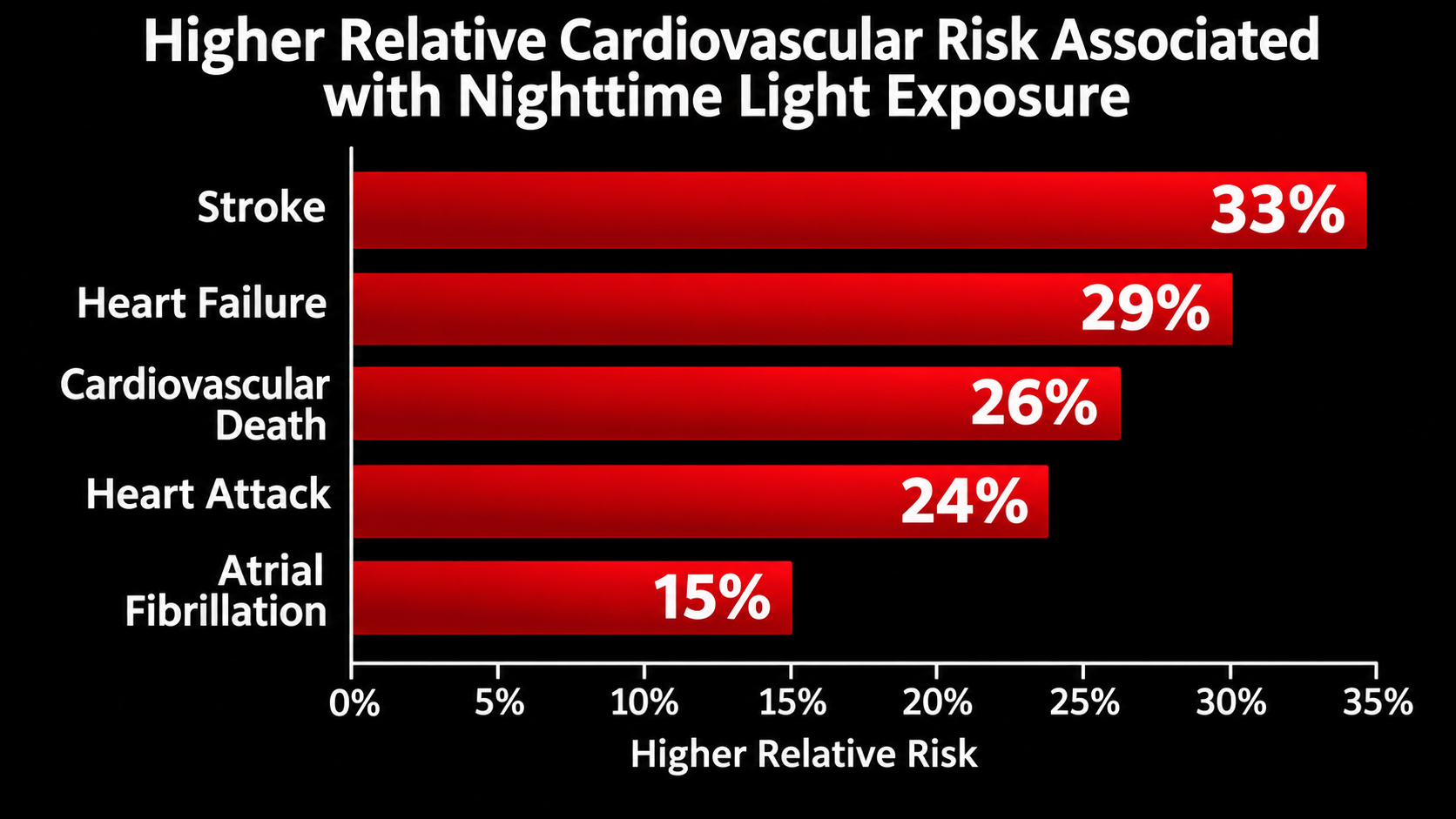
These findings are significant because they suggest that nighttime lighting may affect more than sleep quality. It may also be associated with physical changes in the heart itself.
Why darkness matters to the body
The human body operates according to a roughly 24-hour internal clock known as the circadian rhythm. This biological system helps regulate sleep, hormone production, metabolism, blood pressure and heart rate.
Light is one of the strongest signals controlling that clock.
During daylight hours, natural light helps the body remain alert and active. As darkness approaches, the brain begins preparing the body for rest, including increasing production of melatonin, a hormone associated with the sleep-wake cycle.
Artificial lighting at night can interfere with those signals.
Researchers believe that exposure to light during normal sleeping hours may disrupt the body's ability to regulate its cardiovascular and metabolic functions.
A smaller laboratory study published in 2022 provided additional insight. Researchers at Northwestern University studied 20 healthy adults and found that participants exposed to moderate room lighting while sleeping experienced increased heart rates and greater insulin resistance the following morning compared with those sleeping in dim conditions.
Although the study was small, its findings offered a possible biological explanation for the associations identified in larger population studies.
The evidence is growing, but questions remain
Another major study published in JAMA Network Open in October 2025 followed cardiovascular outcomes among 88,905 adults.
Researchers analyzed approximately 13 million hours of personal light-exposure measurements and found that participants experiencing the brightest nights had higher rates of heart attacks, heart failure, coronary artery disease, irregular heart rhythms and strokes.
The associations persisted even after researchers accounted for several established risk factors, including smoking, physical activity, diet, sleep duration and genetic susceptibility.
However, both major studies were observational. They identified relationships between nighttime light and cardiovascular disease but could not establish that light exposure directly caused those conditions.
Other factors, including shift work, environmental noise, stress and existing health problems, could influence the findings.
There is another important limitation: The studies measured personal light exposure, not the effectiveness of blackout curtains or sleep masks. Researchers have not demonstrated through long-term randomized trials that using either product reduces heart attacks or strokes.
The research also relied heavily on UK Biobank participants, a population that is predominantly white, raising questions about how consistently the findings apply across more diverse communities.
Small changes that could make a difference
While researchers continue investigating the connection between nighttime lighting and cardiovascular disease, creating a darker sleeping environment is a practical, generally low-cost step.
Health experts recommend several approaches:
- Install blackout curtains or shades. Reduce light entering the bedroom from streetlights, passing vehicles and nearby buildings.
- Consider a comfortable sleep mask. An eye mask can help block unwanted light, particularly for people who cannot control their sleeping environment.
- Turn off the television. Avoid falling asleep with bright screens illuminating the room.
- Limit electronic light. Dim or cover unnecessary illuminated displays, chargers and other devices.
- Keep nighttime navigation safe. Use low-level or motion-activated lighting when getting up, especially for older adults and those at risk of falling.
These changes should complement, not replace, established heart-health practices such as controlling blood pressure, exercising regularly, eating a balanced diet, avoiding tobacco and getting adequate sleep.
A wake-up call for our communities
For communities already facing disproportionate burdens of hypertension, diabetes and cardiovascular disease, research into nighttime lighting deserves attention.
African American communities, in particular, have long faced significant cardiovascular health disparities. Improving access to preventive care, nutritious foods, safe neighborhoods and reliable health information remains essential.
A darker bedroom cannot eliminate those inequalities. Nor can it substitute for prescribed medications, regular medical appointments or treatment of sleep disorders such as obstructive sleep apnea.
Nevertheless, the growing body of research challenges us to consider another aspect of preventive health that receives relatively little attention: the environment in which we sleep.
For individuals living in brightly illuminated neighborhoods, working irregular hours or sharing bedrooms with televisions and electronic devices, controlling nighttime light may be more difficult than simply flipping a switch.
That makes this research relevant not only to personal health decisions but also to broader conversations about housing conditions, urban lighting and community wellness.
The Weekly Press perspective: Prevention begins at home
We often think of heart disease prevention in terms of what we eat, how frequently we exercise and whether we visit our doctors.
Those priorities remain essential. But emerging scientific evidence suggests that our nighttime surroundings deserve a place in that conversation.
There is no scientific justification for promising that a $20 sleep mask or a set of blackout curtains will prevent a heart attack. There is, however, credible evidence suggesting that excessive nighttime light exposure may be an overlooked cardiovascular risk factor.
For many households, reducing unnecessary bedroom lighting is a reasonable step toward better sleep hygiene without a significant financial investment.
The larger lesson is that protecting our hearts may require paying attention not only to what we do during the day but also to the conditions we create for rest.
Sometimes, one of the simplest steps toward better health begins when we turn out the lights.


