

2026 Midterm Elections Reveal Deep Racial and Gender Divides Among American Voters
A breakdown of voting preferences in the 2026 midterm elections highlights striking differences among Black, Latino and white voters, with Black women showing the strongest Democratic support and white men favoring Republicans.


By Derek Payne | The Weekly Press
WASHINGTON — The 2026 midterm elections have brought renewed attention to the influence of race and gender on American politics, revealing sharp differences in how major demographic groups supported Democratic and Republican candidates in U.S. House races.
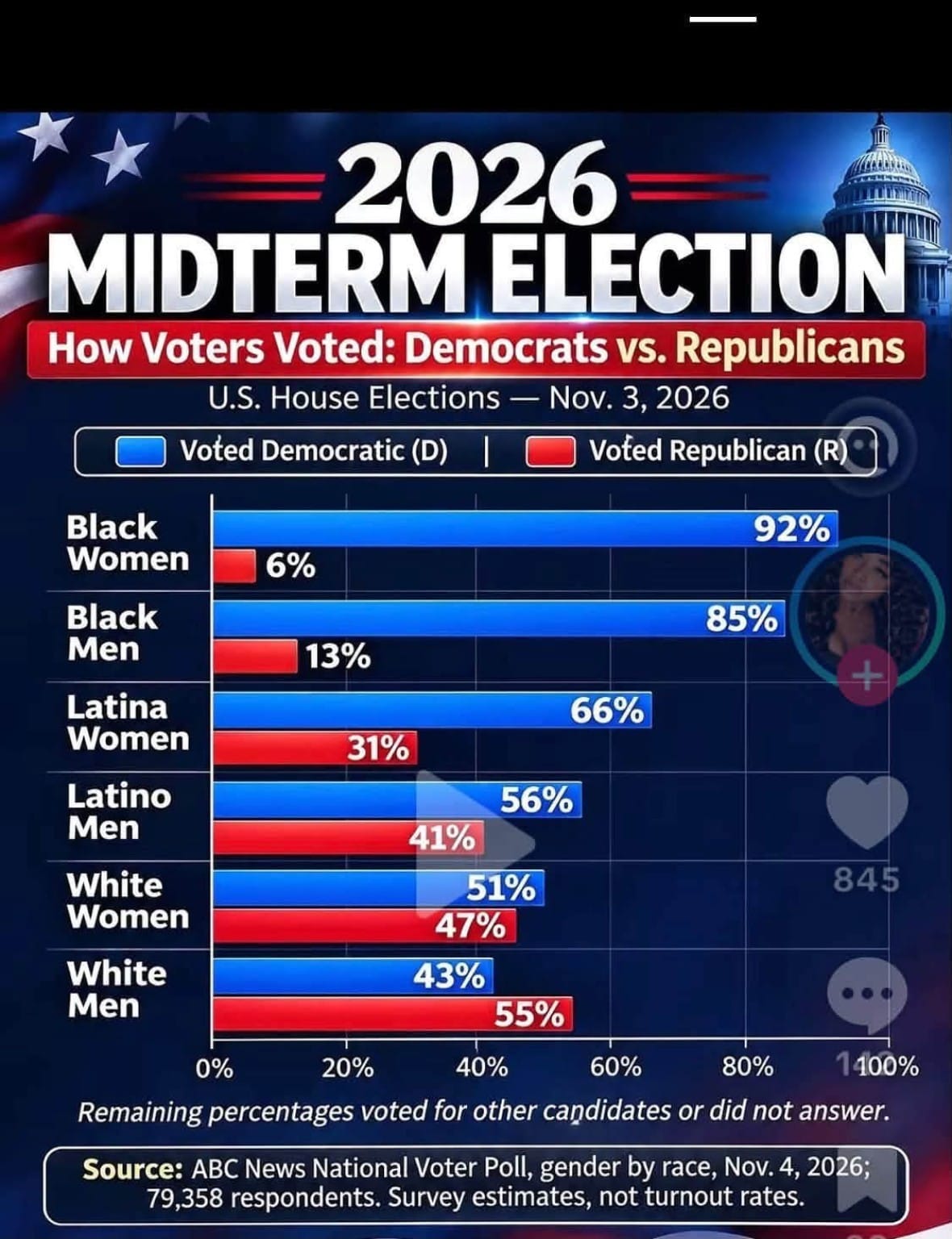
A graphic circulating after the Nov. 3 elections, attributed to the ABC News National Voter Poll, portrays Black women as the Democratic Party's most loyal voting bloc, while white men were the only demographic group shown giving majority support to Republican candidates.
The figures also suggest that Democrats maintained an advantage among Black men, Latino men, Latina women and white women, although the strength of that support varied considerably.
The results, if confirmed by the underlying polling data, would reinforce the importance of demographic coalitions in determining control of Congress and shaping the political direction of the country.
Black women remain a cornerstone of Democratic support
According to the graphic, 92% of Black women supported Democratic House candidates, compared with 6% who supported Republicans — an 86-percentage-point advantage.
Black men also overwhelmingly favored Democrats, with 85% supporting Democratic candidates and 13% backing Republicans.
The findings are broadly consistent with other post-election research. The AP Voter Poll found that approximately nine in 10 Black voters supported Democratic House candidates, with Republican support among Black men falling substantially from the 2024 presidential election.
The results challenge the notion that recent Republican gains among Black male voters necessarily represented a permanent political realignment.
Latino voters shift toward Democrats
The graphic shows Latina women supporting Democrats by 66% to 31%, while Latino men favored Democrats by 56% to 41%.
Those figures are particularly significant following the 2024 presidential election, when President Donald Trump made notable gains among Hispanic voters.
Post-election research indicates that Democrats recovered support among Latino voters in 2026, with economic concerns and immigration enforcement emerging as important factors in their decisions.
The findings suggest that Latino voters remain a competitive and politically diverse constituency rather than a dependable voting bloc for either party.
White voters show a significant gender divide
Among white women, the graphic reports 51% supporting Democrats and 47% backing Republicans.
White men, however, favored Republicans by 55% to 43%, making them the only group among the six displayed to give Republicans a majority.
The narrow Democratic advantage among white women represents a notable departure from the 2024 House election, when national exit polling showed white women favoring Republicans by 55% to 44%.
White men also moved toward Democrats compared with 2024, when Republicans received 62% of their vote.
These changes suggest that dissatisfaction with the country's direction extended beyond traditional Democratic constituencies.
Economic concerns influence voter decisions
The demographic shifts occurred against a backdrop of public frustration over the economy, the cost of living and the direction of the country.
National exit polling found widespread dissatisfaction with economic conditions and indicated that many voters viewed their congressional choices as a referendum on Trump's presidency.
About six in 10 voters said Trump was a factor in their House vote, according to election-night polling.
For Democrats, the results demonstrated an ability to rebuild support among groups that had moved toward Republicans two years earlier. For Republicans, they highlighted the difficulty of maintaining those gains amid economic uncertainty and public dissatisfaction.
What the numbers mean moving forward
The 2026 results underscore an important political reality: Neither party can assume that voter loyalty will remain unchanged from one election to the next.
Black women continued to provide overwhelming Democratic support, while Black men and Latino voters demonstrated the potential for meaningful changes between election cycles. White women emerged as an especially competitive constituency, and white men remained more Republican-leaning.
As both parties begin positioning themselves for the 2028 presidential election, the challenge will extend beyond winning individual demographic groups. Success will depend on turnout, economic credibility, voter engagement, and the ability to build coalitions across racial, gender, and generational lines.
The midterm elections may have revealed where American voters stood in November 2026, but the next two years will determine whether those political allegiances endure.


