

City-Brooks debate shifts from golf course’s future to Baton Rouge’s vision for a major public park
BREC presented its latest concept Monday as officials continue developing a long-term master plan for City-Brooks and the surrounding University Lakes area.


BATON ROUGE, La. — The debate over City-Brooks Community Park is no longer simply about whether Baton Rouge should keep its historic golf course.
It is increasingly about how the city can preserve one of its most recognizable recreational assets while making room for a broader range of residents, activities and public spaces.
BREC presented its latest concept Monday as officials continue developing a long-term master plan for City-Brooks and the surrounding University Lakes area. The proposal would retain the nine-hole golf course but modify its layout, an approach intended to balance preservation with demands for additional walking, biking, family recreation and other park amenities.
The plan represents the latest step in a months-long public process that has produced competing visions for the 150-acre-plus City-Brooks Community Park.
BREC is working with Sasaki, an architecture, planning and design firm, on the master plan. The larger City-Brooks Park and Lakes Vision Plan also examines the future governance and long-term stewardship of the University Lakes system.
“This is a responsibility of listening to the public,” BREC Superintendent Brooks Williams said during Monday’s commission meeting.
Golf remains — but the course could look different
Under the latest BREC proposal, the historic nine-hole course would remain, but portions of the layout would be redesigned.
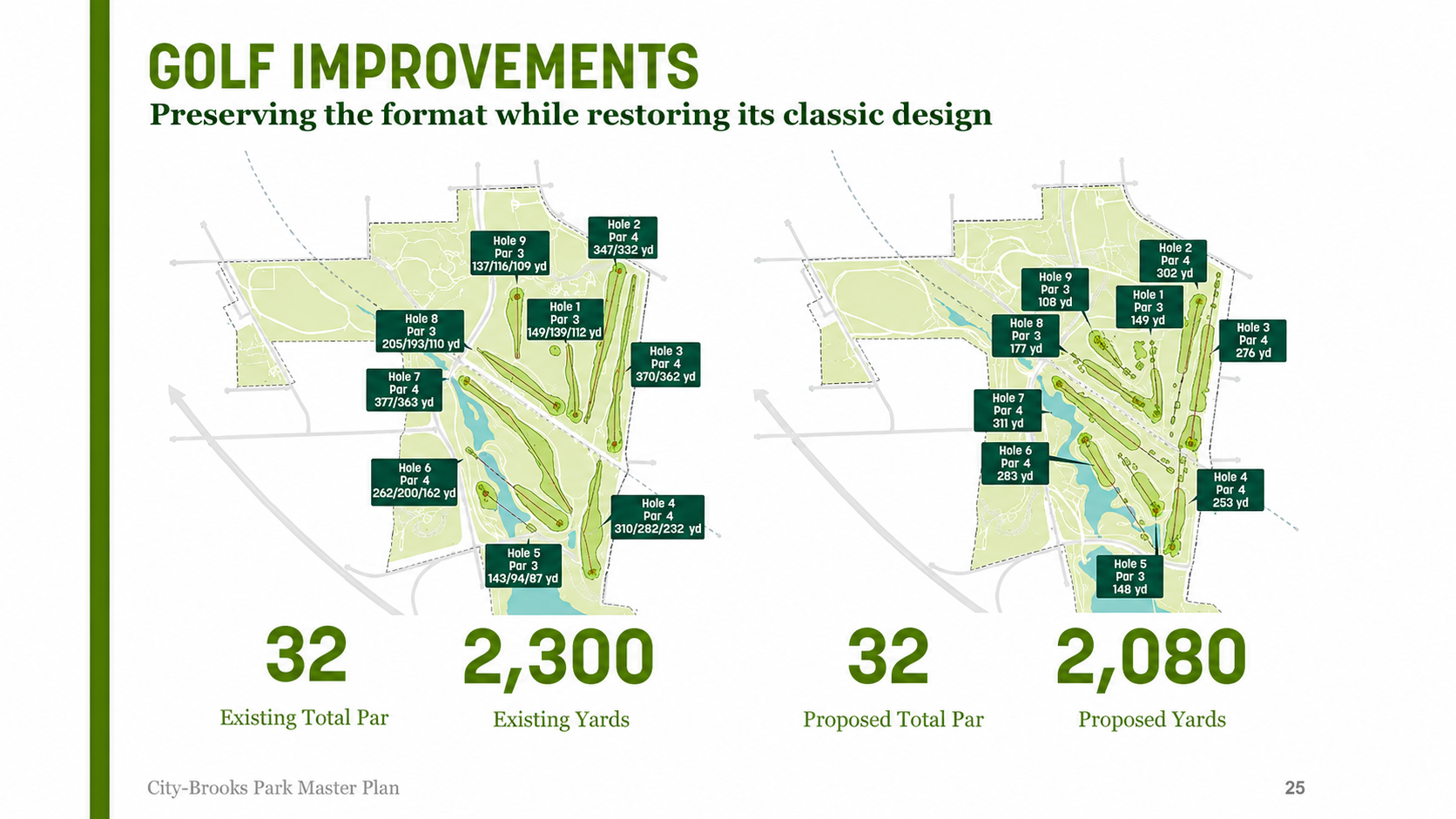
The proposal calls for retaining nine holes and a par of 32 while reducing the course from roughly 2,300 yards to about 2,080 yards.
The change reflects one of the central challenges facing planners: how to preserve golf while creating additional space and connections throughout the park.
City-Brooks’ golf course dates to 1926 and was designed by Tom Bendelow. BREC identifies it as one of 20 courses in the country listed on the National Register of Historic Places. The course occupies about 40 acres and remains one of the park's established recreational features.
Earlier concepts from Sasaki also contemplated modifying the golf footprint to make room for additional recreational uses. Public feedback, however, has demonstrated that there is significant interest in preserving golf at City-Brooks.
The issue has placed BREC in a difficult position: expand the park's offerings without eliminating an amenity that has been part of Baton Rouge's recreational history for generations.
A competing vision
State Rep. Dixon McMakin has continued to advocate for an alternative approach that would leave the golf course substantially unchanged while finding other areas of the park for new amenities.
McMakin said he remains unconvinced that redesigning the course is the best use of public resources.
“I’m not satisfied with it. I think there are still improvements to make,” McMakin said.
His concern centers in part on the amount of earthwork and construction that could be required to relocate and redesign holes.
McMakin has argued that planners should first determine whether the desired improvements can be accomplished without altering the existing course.
His proposal is part of a broader effort to find a compromise between residents who want the historic golf course preserved and those who want City-Brooks redesigned to serve a wider range of recreational needs.
That division has been evident throughout the planning process. Previous proposals have included keeping the golf course footprint largely intact while adding a large walking and running loop, as well as concepts that would shorten the course to create space for other uses.
More than a golf-course decision
The stakes extend well beyond the fairways.
BREC's master plan calls for examining circulation throughout the park, expanded cultural amenities, recreational facilities and stronger connections between City-Brooks and the University Lakes system.
City-Brooks already includes a wide range of amenities, including a playground, swimming pool, tennis facilities, athletic fields, dog park, walking loop, greenway connections and the golf course.
That makes the planning process less about replacing one activity with another and more about determining how the park can function as a comprehensive public destination.
BREC officials have emphasized that public input has played a significant role in shaping the evolving concepts. The agency previously extended the planning timeline to give its design team more time to review community feedback and conduct additional stakeholder discussions.
Commissioner Mike Polito praised the latest concept for maintaining the course's nine-hole format and preserving its par while allowing other improvements to move forward.
Still, opposition to changing the course means the debate is unlikely to end with Monday's presentation.
A decision is still ahead
BREC has not made a final decision on the master plan.
The agency's planning process is expected to continue through the coming months, with a final vote anticipated in the fall.
The scale of the potential investment is significant. BREC has previously presented cost estimates ranging from tens of millions of dollars to more than $100 million depending on the scope and phasing of the improvements, with implementation potentially stretching over many years.
For Baton Rouge, the question is therefore bigger than what happens to nine holes of golf.
It is whether the city can transform one of its most historic public parks while respecting the people who already use it — and whether the final plan can deliver more recreational opportunities without sacrificing the character that made City-Brooks important in the first place.
For now, the golf course remains part of that future. The argument is over how much of its past should come with it.


