
Beyond Red and Blue: What Democrats and Republicans Really Stand for in the 2026 Elections
A viral 2026 election chart misrepresents key Democratic and Republican positions. A closer look reveals the facts behind the political claims and what voters should know before Election Day.


WASHINGTON — With the 2026 midterm elections approaching, Americans are being bombarded with political advertisements, social media graphics and campaign messages promising to explain what is at stake when voters head to the polls Nov. 3.
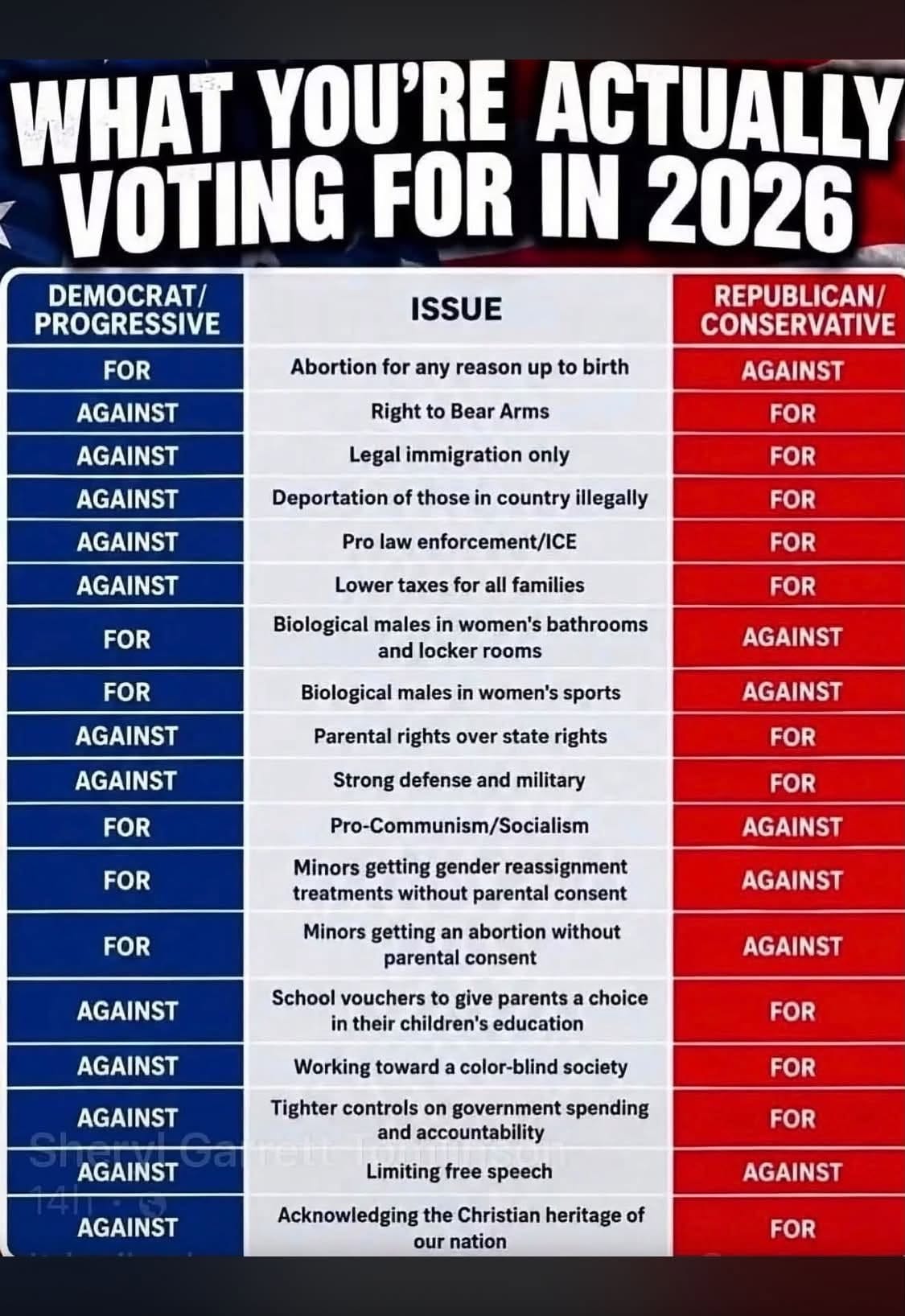
One widely circulated graphic, titled "What You're Actually Voting for in 2026," attempts to summarize the differences between Democrats and Republicans across 18 political and social issues.
The chart presents Democrats as opposing lower taxes, legal immigration, law enforcement, parental rights, military strength and government accountability. Republicans, meanwhile, are portrayed as supporting those positions.
But the comparison tells only part of the story — and in several instances, presents an inaccurate picture of what the two major political parties actually believe.
Although Democrats and Republicans have substantial disagreements over abortion, immigration, education, taxation and other issues, many of their differences involve how policies should be implemented rather than whether the underlying goals are important.
A closer look at the parties' published platforms reveals a considerably more complicated political landscape.
Abortion: A Disagreement Over Access and Restrictions
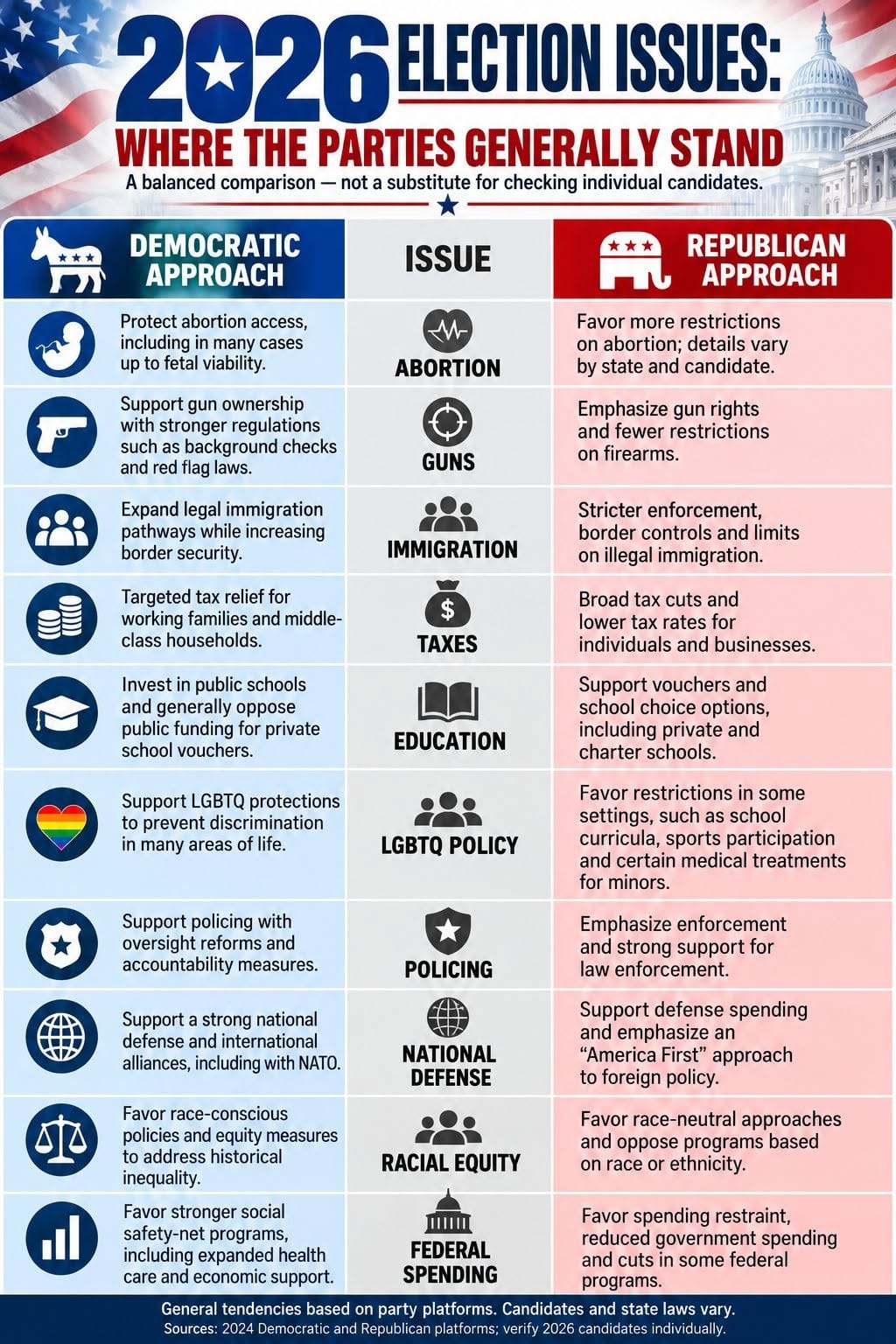
One of the most misleading claims in the viral chart is that Democrats support abortion for any reason until birth.
The Democratic Party generally supports protecting reproductive rights and restoring federal abortion protections previously recognized under Roe v. Wade.
Those protections permitted states to regulate abortion after fetal viability, subject to exceptions involving the pregnant patient's life or health.
Republicans generally favor greater abortion restrictions, although their positions differ regarding exceptions, gestational limits and whether regulations should be established by state or federal governments.
The Republican Party's 2024 platform emphasized state authority over abortion policy following the Supreme Court's 2022 decision overturning Roe v. Wade.
The disagreement is therefore not accurately described as one party supporting unrestricted abortion and the other opposing abortion under every circumstance.
Gun Rights: Ownership Versus Regulation
The viral chart suggests Democrats oppose the constitutional right to bear arms.
In reality, both parties recognize the Second Amendment, but they differ over the extent of government regulation.
Democrats generally support stronger background checks, restrictions on certain firearms and measures intended to prevent gun violence.
Republicans generally emphasize protecting gun ownership rights and oppose many additional firearm restrictions.
The central disagreement involves balancing gun rights with public safety measures.
Immigration: Both Parties Support Legal Immigration
Perhaps one of the clearest inaccuracies in the graphic is the suggestion that Democrats oppose legal immigration.
Both major political parties support legal immigration, although they disagree over immigration levels, enforcement methods and pathways to lawful status.
Democrats generally favor expanding certain legal immigration opportunities, protecting eligible undocumented immigrants and combining border security with immigration system reforms.
Republicans generally emphasize stricter border enforcement, deportations, immigration screening and restrictions on unlawful entry.
Democratic and Republican administrations have both conducted deportations.
The debate centers largely on the scope of enforcement, humanitarian protections and how immigration laws should be administered.
Taxes: Different Approaches to Financial Relief
The viral chart portrays Republicans as supporting lower taxes for all families while suggesting Democrats oppose tax reductions.
That characterization overlooks the fact that both parties have supported tax relief.
Democrats generally favor targeted tax benefits for working- and middle-class households, including expanded tax credits, while advocating higher taxes on some wealthy individuals and corporations.
Republicans generally favor lower tax rates, broader tax reductions and policies intended to encourage private investment and business growth.
The parties disagree primarily over who should receive the largest benefits, how tax reductions should be financed and how tax policy affects economic growth and federal deficits.
Education: Public Schools and Parental Choice
Education represents another significant policy disagreement.
Democrats generally emphasize public school funding, teacher support and educational equity. Many oppose using taxpayer funds for private-school voucher programs because of concerns about diverting resources from public education.
Republicans generally support expanded school choice, including charter schools, private-school vouchers and greater parental influence over educational decisions.
Both parties say parents should play an important role in their children's education.
However, they disagree over curriculum decisions, school governance, student privacy and the appropriate limits of parental authority.
Describing Democrats as simply opposing parental rights does not accurately reflect the complexity of those disagreements.
LGBTQ Rights: Competing Views on Protections and Restrictions
The viral chart uses emotionally charged language when discussing transgender participation in sports, bathroom access and medical treatment for minors.
Democrats generally support broader legal protections against discrimination based on sexual orientation and gender identity.
Republicans generally favor restrictions in certain settings, including participation in girls' and women's sports, some school policies and certain gender-related medical treatments for minors.
These debates involve competing arguments about individual rights, privacy, fairness, parental involvement and medical oversight.
Importantly, laws governing medical consent for minors vary by state. Broad claims that one political party universally supports medical procedures for children without parental involvement omit essential legal context.
Law Enforcement: Public Safety and Accountability
The viral graphic claims Democrats oppose law enforcement while Republicans support it.
Both parties support public safety, although they emphasize different approaches to policing and criminal justice.
Democrats generally advocate police accountability, improved training, community-based crime prevention and reforms intended to reduce misconduct.
Republicans generally emphasize stronger enforcement, support for police departments and tougher penalties for certain crimes.
The disagreement is not whether communities need protection, but how public safety should be achieved and how law enforcement agencies should be held accountable.
National Defense: Different Strategies, Shared Security Goals
The suggestion that Democrats oppose a strong military is also inaccurate.
Both major parties support maintaining a capable national defense.
Democrats generally emphasize international alliances, diplomatic cooperation and military partnerships, including NATO.
Republicans generally emphasize military readiness, defense capabilities and an America First approach to foreign policy.
Although their priorities and strategies differ, neither party's official platform advocates abandoning national defense.
Racial Equality: Different Approaches to Addressing Discrimination
The chart claims Democrats oppose a color-blind society.
This characterization oversimplifies an ongoing national debate over equality and discrimination.
Democrats generally support policies designed to address historical and systemic inequalities, including certain race-conscious initiatives and diversity programs.
Republicans generally favor race-neutral policies and oppose many government programs that explicitly consider race or ethnicity.
Both parties publicly endorse equal treatment under the law, but they disagree over whether race-conscious policies promote or undermine that objective.
Government Spending: Competing Budget Priorities
Another misleading claim suggests Democrats oppose tighter government spending controls and accountability.
Both parties advocate responsible government spending, although they differ over which programs deserve funding and which expenditures should be reduced.
Democrats generally support stronger federal investment in health care, education, infrastructure and social safety-net programs.
Republicans generally advocate spending restraint, reductions in certain domestic programs and a smaller federal role in some areas of the economy.
However, neither party has consistently eliminated federal deficits when controlling the government.
A party's commitment to fiscal responsibility is best evaluated through actual budgets, legislation and spending decisions rather than campaign slogans.
Free Speech and Religious Freedom
The original chart also claims Democrats favor limiting free speech and oppose acknowledging America's Christian heritage.
Neither characterization accurately summarizes the party's official position.
Both Democrats and Republicans affirm constitutional protections for freedom of speech and religion.
Disagreements arise over issues such as online content moderation, protest restrictions, educational materials, religious expression in public institutions and the relationship between government and religion.
Christianity has played an important role in American history, but recognizing that historical influence is different from establishing government preference for a particular religion.
The First Amendment protects both religious exercise and freedom from government establishment of religion.
Why Political Graphics Can Be Misleading
The viral chart illustrates a growing challenge in modern political communication: complex policy disagreements are frequently reduced to simple, emotionally charged statements.
A format that places "FOR" and "AGAINST" beside each political party may be easy to understand, but it can also create a false impression that every issue has only two possible positions.
Political parties are not uniform organizations. Individual candidates frequently disagree with portions of their own party's platform, and positions can vary significantly between states and congressional districts.
Voters also should distinguish between campaign promises, official party platforms, proposed legislation and actual voting records.
A political graphic can contain elements of truth while still misleading readers through selective wording, omitted context or exaggerated conclusions.
What Voters Should Consider Before Election Day
The 2026 midterm elections will determine control of Congress and numerous state and local offices.
Rather than relying on viral social media comparisons, voters should examine candidates' public statements, legislative records, policy proposals and positions on issues affecting their communities.
The Democratic and Republican parties offer competing visions for government, economic policy, civil rights, education and national security.
Understanding those differences requires more than a red column, a blue column and a collection of one-word answers.
The bottom line: Americans are not simply voting for or against a list of political slogans. They are choosing candidates whose decisions will influence public policy, government spending, individual rights and the direction of the country.
In an election season filled with political messaging, informed voting begins with separating verifiable facts from partisan persuasion.


